New development
We develop geometry, circuitry and integration based on your frequency bands, installation conditions and measurable target values.
CONTRACT DEVELOPMENT
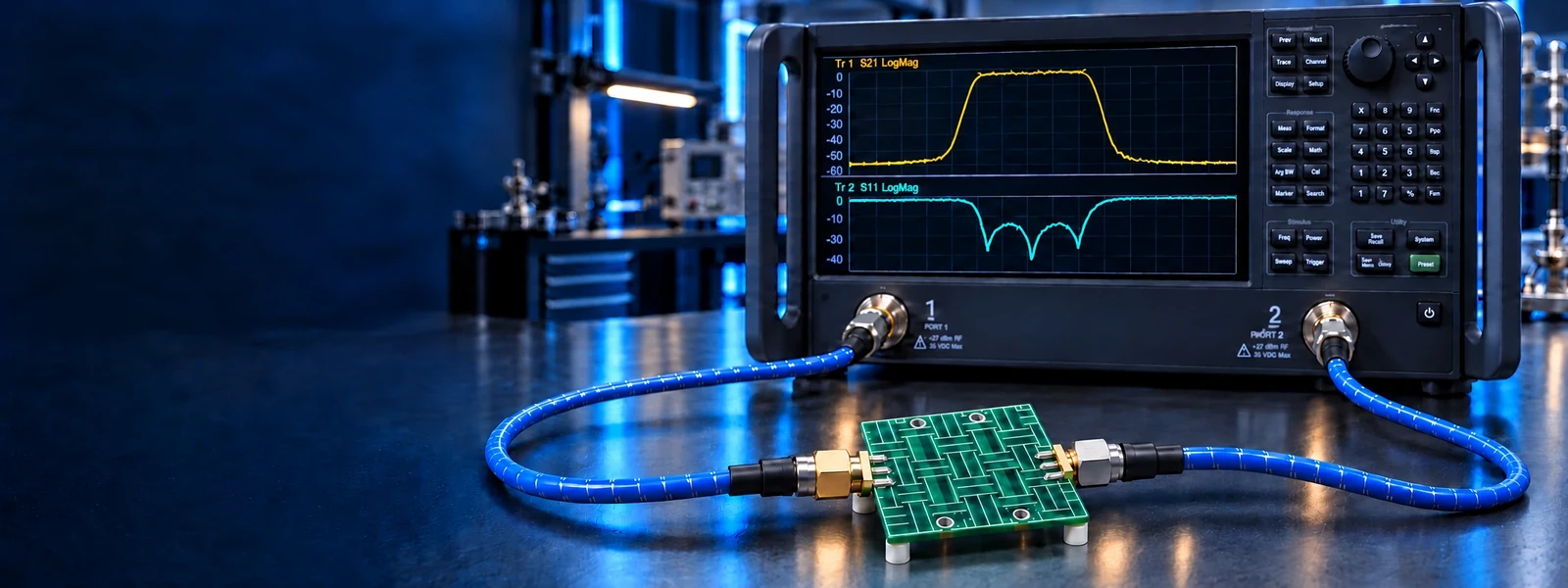
We develop RF filters for transmit, receive and measurement paths. The pass band, stop bands and insertion loss are coordinated with impedance, installation space and interference environment.
01 / TECHNOLOGY & DEVELOPMENT
We design filters according to the required function. Protecting a sensitive receiver from a neighboring transmitter requires different priorities than suppressing harmonics in the transmission path.
02 / TECHNOLOGY & DEVELOPMENT
The ideal circuit is the starting point. Pads, lines, via structures, component models and connectors influence the real filter characteristic and must be included in the optimization.
03 / TECHNOLOGY & DEVELOPMENT
We manufacture and measure prototypes and compare the model with the measurement data. The pass and stop ranges are released based on specific frequency points and limit values.
THREE WAYS TO THE RIGHT SOLUTION
We develop geometry, circuitry and integration based on your frequency bands, installation conditions and measurable target values.
We analyze existing samples and documents, determine the cause of losses or inadequate performance and implement targeted changes.
We check an existing Sevskiy solution and adjust frequency tuning, connections or installation. We can handle mass production upon request.
OUR APPROACH
We clarify the frequency plan, installation space, mechanical environment, supply, connections and test criteria. Existing CAD, circuit and measurement data are incorporated.
We compare suitable concepts, design the circuit or geometry, and simulate critical electromagnetic structures and transitions.
We build prototypes, measure under defined conditions and fine-tune the design based on the comparison between the model and the real structure.
We document the agreed design and test plan. Production support and management of mass production are agreed as required.
YOUR RESULT
You receive the filter design with layout or mechanical implementation, interfaces and agreed measurement data. We also examine the customization of an existing Sevskiy filter and handle mass production if desired.
FREQUENTLY ASKED QUESTIONS
Passband, stopband frequencies and required attenuation, maximum insertion loss, connection impedance, signal level, installation space and connectors.
We check topology, material and dimensions. An adjustment of resonators or component values may be possible; The scope is determined using simulation and sample testing.
PRODUCTS AS A STARTING POINT
Discover the appropriate product group →YOUR RF TASK
Tell us pass and stop ranges, permissible insertion loss, signal level and installation space. From this we develop a suitable filter concept.