Your specialist in custom antenna and RF development and production
We develop, optimize and deliver your RF solution – from the antenna to the radio chip.
New development. Optimization. Product customization.
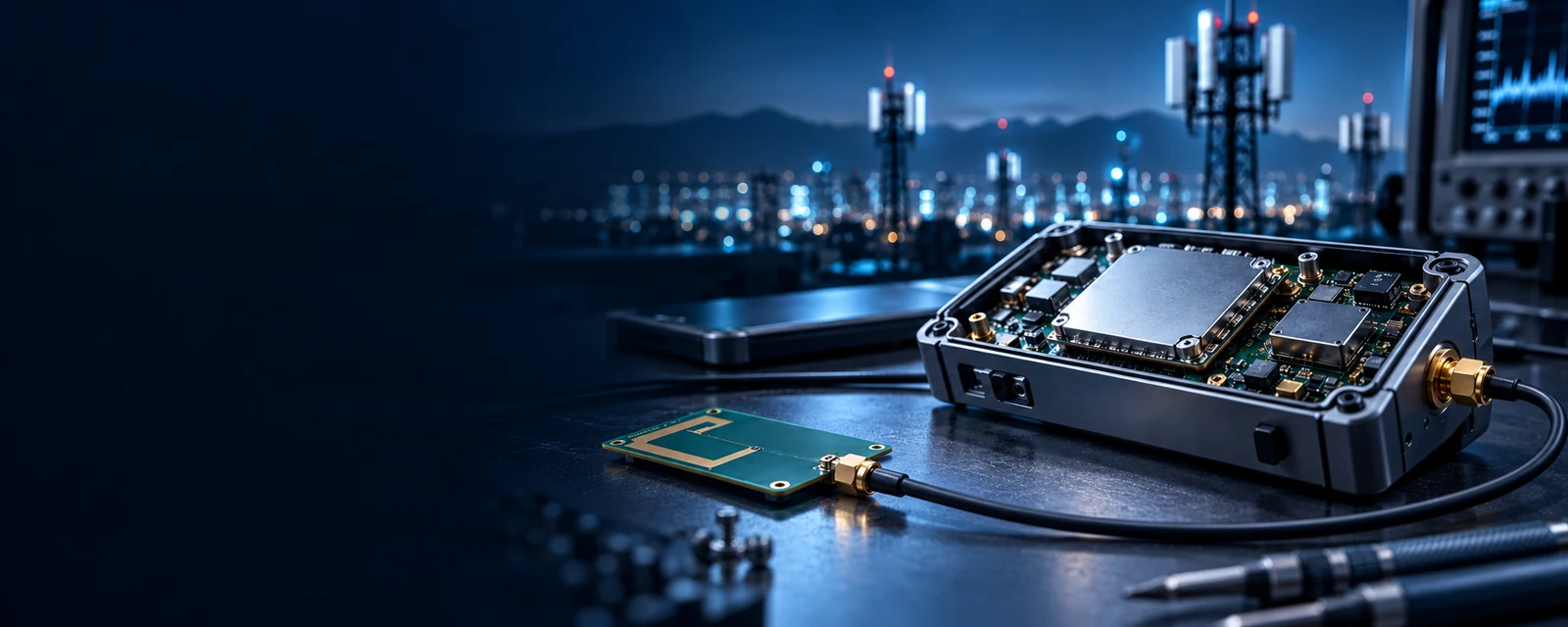
01 / LTE · 5G · WLAN · Bluetooth
Mobile communication
Radio modules, routers, mobile devices and reference platforms require antennas with sufficient bandwidth and controlled coupling to neighboring radio paths.
Wireless standards and frequencies
Cellular for example 700–960 MHz, 1.7–2.7 GHz and 3.3–3.8 GHz; WLAN in the 2.4 and 5 GHz band, depending on the product also 6 GHz.
Our services
We develop multiband and MIMO antennas, design matching networks and filters, evaluate receive amplifiers and optimize cable connections and RF traces up to the transceiver.

02 / Reader · Tags · NFC · Access
RFID and identification
We develop antennas for readers, transponders, payment cards and access systems. The coupling to the counterpart as well as the influence of metal, housing and installation location are particularly important.
Wireless standards and frequencies
HF RFID/NFC at 13.56 MHz; UHF RFID typically 865–868 MHz in Europe and 902–928 MHz in North America.
Our services
Our scope extends from coil and UHF antennas to resonance tuning, matching networks and filters to the RF-compatible reader board, cable connection and measurement in the target device.

03 / Radio reception · Telematics · Vehicle access · Radar
Automotive and vehicle technology
Vehicle keys, telematics modules and antenna modules must function in the vicinity of the body, wiring and other electronics. Our projects include 433 MHz PCB antennas and multi-antenna modules for LTE, WLAN and Bluetooth.
Wireless standards and frequencies
AM in the respective regional broadcast band; FM/VHF typically 87.5–108 MHz, DAB/DAB+ in band III at 174–240 MHz and SDARS in the S-band around 2.3 GHz. There are also 433 MHz access systems, GNSS, LTE/5G, WLAN and, depending on the project, V2X at 5.9 GHz and radar at 24 GHz.
Our services
We develop active FM, AM/FM, DAB and SDARS antennas including amplifiers, filters, matching and supply. There are also combination antennas for communication and navigation, MIMO decoupling and the optimization of installation location, cables, connectors and RF PCB junctions.

04 / Communication · Navigation · Calibration
Aerospace
We develop and investigate antennas for aircraft, scientific telemetry and satellite-based radio links. This includes evaluating the aircraft structure and mounting position as well as transmitting and receiving assemblies with patch and quadrifilar helix antennas.
Wireless standards and frequencies
Project-related design, for example at 164 MHz in the VHF range, 402.25 and 468.25 MHz for scientific telemetry as well as at 9.65 GHz in the X-band and 14.85 GHz. We coordinate GNSS bands and other mission frequencies with you.
Our services
We simulate the antenna, radome and support structure, optimize the radiation pattern and polarization and evaluate matching, gain, axial ratio and, if necessary, the phase center. We include feed networks, filters, LNA, cables and RF transitions in development, measurement planning and measurement validation.

05 / SATELLITE COMMUNICATION · NAVIGATION
Satellite communications and navigation
We develop antennas and RF assemblies for satellite-based navigation and communication. Our experience includes different active GNSS antennas across all GNSS frequency bands as well as solutions for Iridium and SDARS. We design each development based on the signals actually required, the available installation space and the installation situation. The band coverage depends on the respective project.
GNSS, Iridium and SDARS
For GNSS, we cover GPS, Galileo, GLONASS and BeiDou. Designs range from compact single-band antennas to multiband solutions with a coordinated active receive chain. Relevant carrier frequencies include GPS L1 at 1,575.42 MHz, L2 at 1,227.60 MHz and L5 at 1,176.45 MHz. Galileo uses E1 at 1,575.42 MHz, E5a at 1,176.45 MHz, E5b at 1,207.14 MHz and E6 at 1,278.75 MHz. BeiDou bands include B1I at 1,561.098 MHz, B1C at 1,575.42 MHz, B2a at 1,176.45 MHz and B3I at 1,268.52 MHz.
For Iridium, we consider the L-band range from 1,616 to 1,626.5 MHz. SDARS reception for the US market uses the S-band from 2,320 to 2,345 MHz. Transmit and receive requirements, polarization and nearby wireless systems determine the antenna concept.
Our services
We coordinate the antenna geometry, matching network, low noise amplifier (LNA) and filter and include PCB layout, supply, cables and connectors. For active GNSS antennas, we evaluate the gain, noise behavior, losses and interference immunity of the reception chain together. Simulation, prototypes and measurements in the intended structure lead to a solution whose properties are clearly documented for further product development. Housings, ground planes and neighboring electronics are taken into account early on.

06 / Control · Telemetry · Video · GNSS
Drones and unmanned systems
Low weight, little installation space and several transmitters active at the same time make antenna integration challenging. We support the design of radio links and the suppression of disruptive harmonics.
Wireless standards and frequencies
For video, analog FPV transmission and digital systems such as DJI O3/O4, HDZero and Walksnail Avatar are used, often in the 5.8 GHz range; depending on the system also at 2.4 or 5.2 GHz. Control and telemetry use, among other things, 433/868 MHz or 2.4 GHz, navigation uses the GNSS bands. The bands that can be used depend on the system and country.
Our services
We develop linear and circularly polarized antennas, diversity arrangements, RF filters and reception front ends for the radio hardware used. We check decoupling between video, control and GNSS, harmonic suppression, cable losses and impedance-controlled layout up to the radio chip.

07 / Positioning · Networking · Sensors
Autonomous vehicles and robotics
Navigation, radio communication and radar sensors must work together on the same platform. Antenna position, shadowing and interference influence the system performance.
Wireless standards and frequencies
GNSS L-band, LTE/5G and WLAN; Project experience with radar at 5.8, 24 and 60 GHz.
Our services
We develop and evaluate antennas and arrays, filters, LNA and signal distribution. There are also cable routes, RF transitions and the layout of the communication and sensor boards.

08 / Wireless data · Energy · Compact devices
Medical and biotechnology
For portable devices, wireless measurement systems and implant-related applications, we analyze the coupling to the environment, the available energy and the influence of the housing and proximity to the body.
Wireless standards and frequencies
Experience with inductive energy transfer at 100–200 kHz and radio applications at 2.4 GHz; additional bands are determined on a device-specific basis.
Our services
We design coupling coils and integrated antennas, investigate filtering and low-noise receive paths, and optimize the PCB, shielding and cable connections. This includes BLE sensors, RF windows and antenna integration in metallized enclosures. Requirements for the medical device are defined for each project.

09 / LPWAN · Meters · Sensors · M2M
IoT and Smart Metering
Water meters, level sensors and battery-powered data loggers need reliable wireless links despite limited ground planes, unfavorable mounting positions and interfering metal parts.
Wireless standards and frequencies
LoRa/Sigfox for example in the European 868 MHz range, regionally also 915 MHz; NB-IoT and LTE-M in the respective cellular bands; Bluetooth at 2.4 GHz.
Our services
We tune internal and external antennas in the device, develop filters and matching, test the benefits of LNAs and reduce losses on traces, coaxial cables and transitions.

10 / Machines · Industrial PCs · Sensors
Industry and automation
Metal housings, control cabinets, motors and power supplies determine the electromagnetic environment of industrial radio technology. We develop antennas for machines, sensors and industrial computers.
Wireless standards and frequencies
Typical project bands: 868 MHz, 2.4/5 GHz and LTE/5G. We have experience at 2.45 GHz for industrial microwave processes.
Our services
We work on MIMO antennas, filters, amplifiers and shielding and evaluate supply, cable and RF layout. For industrial microwave and quantum sensors, we also investigate resonant near-field antennas, field homogeneity and installation space. High power applications also require analysis of field distribution and shielding.

11 / GNSS · Navigation · Data connections
Shipping and maritime systems
Metallic structures and long cable runs influence the antenna pattern and reception losses. Our experience includes an active patch array for a high-precision maritime GPS receiver.
Wireless standards and frequencies
GNSS in L-band; additional mobile and local radio connections depending on the area of operation.
Our services
We develop antennas and feed networks, design LNAs and filters, and examine cable attenuation, connectors, power supply and RF transitions. Mechanical constraints and the operating environment are included in the design.

12 / Bluetooth AoA · UWB · LTE · GNSS
Location and asset tracking
We develop integrated antennas and arrays for angle determination for transponders and positioning systems. Reproducible phase relationships and low coupling are particularly important in direction finding.
Wireless standards and frequencies
Bluetooth at 2.4 GHz, GNSS in L-band and LTE-M/NB-IoT for data transmission; UWB channels are defined module-specifically. Satellite-based IoT connections (NTN) can also be included in the antenna and front-end design.
Our services
We develop array geometry, RF switching, controlled-phase transmission-line routing and matching and measure phase position, isolation and radiation pattern. For compact trackers, we coordinate the GNSS antenna, LNA, cellular and, if necessary, NTN antenna with the battery, housing, cables and RF layout.

13 / LTE-MIMO · GNSS · Passenger information
Railway and public transport systems
We integrate communication and navigation antennas for safety and information systems. Our work includes integrating two LTE-MIMO antennas together with an active GNSS antenna.
Wireless standards and frequencies
LTE bands of the modem used, GNSS in the L band and WLAN at 2.4/5 GHz for local connections.
Our services
We handle antenna positions and decoupling, GNSS-LNA, filtering and supply as well as cable connections and impedance-controlled layout. The test is carried out under the agreed installation conditions.

14 / Lights · Displays · Electronic locks
Smart lighting and building technology
LED drivers, metal reflectors, displays and lock mechanisms can detune antennas and disrupt reception paths. We develop radio antennas for integration into these devices.
Wireless standards and frequencies
Bluetooth and WLAN at 2.4 GHz, WLAN also at 5 GHz, Z-Wave for example 868.42 MHz in Europe or 908.42 MHz in the USA.
Our services
We compare installation locations, simulate housing influences and optimize matching, filtering and layout. Measurements in the finished device connect antenna performance with actual radio coverage.
Designed for your system.
The frequencies mentioned describe typical application or project areas. Channel assignment, permissible transmission power and approval requirements depend on the radio standard, country and product. We determine the bands and test targets required for your device before development begins.
YOUR REQUIREMENTS
Let’s discuss your application.
Frequency bands, installation space, housing and target values are our starting point.